
Human-Centred Behaviour & Research
This programme focuses on building the capability to plan and conduct human-centred research that generates meaningful insights for change and innovation.
Research & Humanity
Human-Centred Behaviour & Research
This programme focuses on building the capability to plan and conduct human-centred research that generates meaningful insights for change and innovation.
Because the most powerful interventions start with the right questions — and those can’t be found in reports or surveys alone. In an age of automation, insights are increasingly pulled from dashboards, sentiment analysis, and algorithmic trends. But public and social change doesn’t happen in a spreadsheet. It happens in real people’s lives.
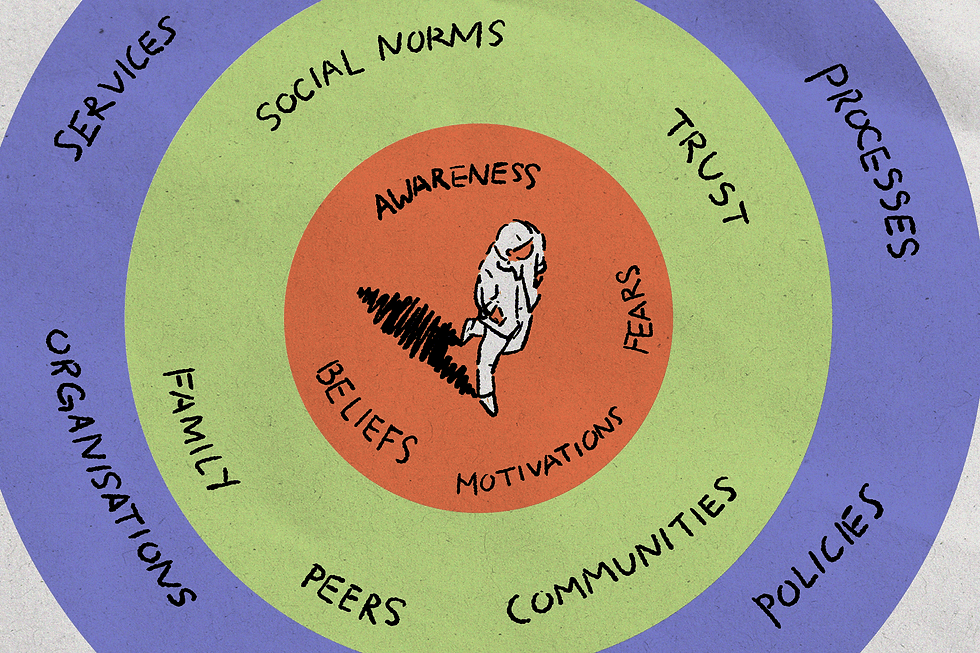
This course invites you to go under the surface — to listen more deeply, question more intentionally, and design interventions rooted in behavioural science and lived reality. As AI takes over routine tasks, your role isn’t to keep up, it’s to go deeper. The real value lies in your human ability to sense, listen, and interpret what matters, not just what’s said, but what’s unsaid. It blends ethnographic research, design research methods and behavioural frameworks like UNICEF’s Behavioural Design Model and the Socio Ecological Model (by Urie Bronfenbrenner) to sharpen how you gather, make sense of, and act on insight.
You’ll leave with tools that aren’t just rigorous — they’re human, ethical, and useful.
Upcoming sessions
17 July, 2026
9:30am – 5:30pm SGT
SGD 650 per participant (excluding 9% GST)
Venue: In-person, Singapore, location TBA
(Each run will proceed with a minimum class size of 10 participants)
Interested in bringing this workshop to your country? Please contact us at info@thinkplace.com.sg.

Who is this programme for and what will you learn

Designed for service designers, customer experience teams, innovation teams, transformation teams, and policy teams, as well as NGOs, social impact organisations, and community engagement practitioners, this programme is ideal for anyone working at the intersection of people, policy, services, and systems who wants to strengthen their human-centred research and design capabilities to create more meaningful and effective solutions.
Learning Outcomes

Learn how to plan and design immersive research and fieldwork that will provide meaningful inquiries that reflects how people behave, what people really think and feel.
Use tools such as Affinity Mapping and Socio-Ecological Model to decode what shapes behaviour in the psychological, social and environmental aspects and across multiple levels of influence.
Learn how to move from research to insights, narratives and possible interventions — whether for service improvement, behaviour change, communications strategy or policy reviews — with clarity and impact.
Segment 1: Human-Centred Design Begins with Curiosity
In a world increasingly driven by automation and data, meaningful research must return to where real interactions happen: with people. This segment introduces the core principles of human-centred research, helping participants look beyond surface findings to understand underlying behaviours and uncover the root causes of problems.
Segment 2: Designing the research, who and how
A critical part of human-centred research is designing a plan that uncovers fresh insights—not one that simply validates what is already obvious. Participants will learn how to scope a research plan, define customer segments through behavioural approaches, and design effective research methods using probes, storytelling techniques, and conversation prompts.
Segment 3: The Power of Firsthand Fieldwork
This segment reawakens the leader-researcher within, inviting participants to experience the messiness and richness of human behaviour through firsthand fieldwork. They learn how to observe what people do (not just what they say) and have conversations to deep dive into how context, rituals, and social environments shape real decisions. Beyond frameworks, this segment cultivates presence, openness, and humility — the foundations of meaningful insight.
Segment 4: From Insight to Stories that Shift Systems
This segment introduces participants to sense-making models such as Affinity Mapping, Personas, the Socio-Ecological Model (SEM), and Behavioural Insights to uncover patterns, influences, and meaning from research. Participants will learn to write insights that resonate, craft personas that feel authentic, and frame intervention options as opportunity areas that communicate research in ways that inspire decision-makers and project teams.
Programme outline
Meet your trainer

Regional Director, ThinkPlace Singapore and Asia
Dr. Debbie Ng
Dr. Debbie Ng, PhD, is a distinguished design leader with over 18 years of experience driving transformative change across complex public and social challenges through human-centred design. As Regional Director of ThinkPlace Singapore and Asia, she collaborates with organisations across sectors to shape innovative, sustainable futures, leveraging design as a powerful force for social good. Debbie is a pioneer of the design thinking initiative in Singapore in 2007, and continued to serve under various capacities in the Public Service Division of the Prime Minister's Office, SPRING Singapore and Singapore Polytechnic.
Debbie excels in navigating intricate, multi-dimensional problems where solutions are ambiguous, applying her expertise in design leadership, complex systems thinking, ethnography, co-design, and service design.
Fueled by a deep commitment to empowering others, Debbie dedicates herself to building internal change and transformation teams and coaching leaders to be empathetic, creative and adaptive leaders.